
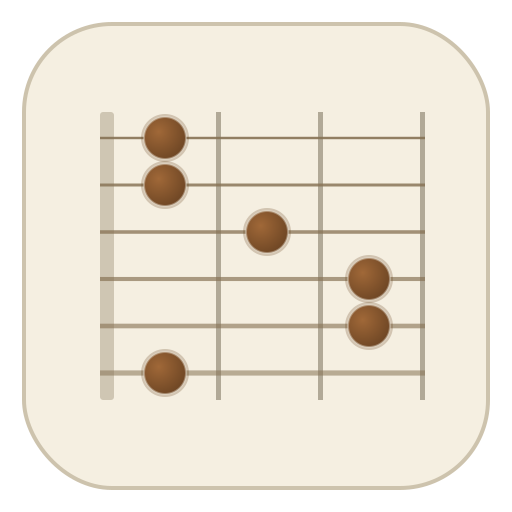

Why barre chords matter
Open chords only exist for a handful of roots. There is an open E, A, D, G and C, but no open B♭, F♯ or E♭. A barre chord solves that by taking an open shape and moving it up the neck, with your index finger laid across the strings doing the job the nut did. Because the shape doesn't change, one shape gives you all twelve roots.
Two shapes do most of the work: the E shape, with its root on the low E string, and the A shape, with its root on the A string.
The E shape: root on the 6th string
Play an open E major with your middle, ring and little fingers instead of the usual index, middle and ring. That leaves your index free. Slide the whole shape up one fret and lay the index across all six strings at the 1st fret, and you have F major. Up two more frets is G, and so on: the chord is named after the note your index finger holds on the low E string.
The minor and 7th versions work the same way. Open Em and open E7 slide up into barre shapes too, so once you have the major barre you have three chord types on every root.
The A shape: root on the 5th string
The same move works on open A. Lay the index across the top five strings, and fret the D, G and B strings two frets higher, either with three fingers or with the ring finger flattened across all three. The root is the note under your index on the A string. The high E string is the hard part of the flattened-ring version; many players just let the ring finger mute it.
Between the two shapes, you can play any major or minor chord within the first seven frets, and choose between two places on the neck for each one. That choice is the real payoff. In a song in G, play G as an E shape at the 3rd fret, C as an A shape at the same fret, and D as an A shape at the 5th, and your hand hardly moves. Pick whichever shape is closest to the chord before it.
Finding the root
A barre chord is only as useful as your ability to find its root. These are the notes on the two root strings. The dots on the neck at 3, 5, 7, 9 and 12 make good landmarks: the 5th fret of the low E is A, and the 5th fret of the A string is D.
| Fret | 0 | 1 | 2 | 3 | 4 | 5 | 6 | 7 | 8 | 9 | 10 | 11 | 12 |
|---|---|---|---|---|---|---|---|---|---|---|---|---|---|
| Low E | E | F | F♯/G♭ | G | G♯/A♭ | A | A♯/B♭ | B | C | C♯/D♭ | D | D♯/E♭ | E |
| A | A | A♯/B♭ | B | C | C♯/D♭ | D | D♯/E♭ | E | F | F♯/G♭ | G | G♯/A♭ | A |
Getting a barre to ring
Barre chords are the point where a lot of beginners stall. The problem is usually technique, not strength.
- Roll the index finger slightly onto its side, toward the headstock. The bony edge presses more evenly than the soft underside, and the creases at your knuckles stop landing on strings.
- Keep the barre close to the fret wire. The same rule as single notes, and it matters more here because one finger is covering six strings.
- Pull back with the arm, don't squeeze with the thumb. Let the weight of your arm draw the neck toward you. Squeezing tires your hand within a minute.
- Only the strings that need it. In an E-shape major, the index only has to hold the low E, B and high E; the other fingers cover the rest. Pressure on the middle of the barre is wasted.
- Learn it higher up first. Frets are closer together and the strings sit lower around the 5th fret, so an A at the 5th fret is easier than an F at the 1st. Work your way down once the shape is solid.
- Check the guitar. If the strings sit high off the fretboard near the nut, barres at the 1st fret will be hard for anyone. A setup at a guitar shop can lower them.
Then check string by string, as with any new chord. Put the shape on the fretboard to hear how each string should sound.
CAGED: five shapes, one chord, the whole neck
The E and A shapes aren't the only open chords that move. C, A, G, E and D all do, and if you slide each one to the position where it makes the same chord, they line up along the neck in that order, which is where the name CAGED comes from. Here they are for C major, from the nut up:
After the D shape comes the C shape again, an octave up at the 12th fret, and the cycle repeats. Every chord has the same five shapes in the same order; only the starting point moves. For A major the cycle starts with the open A shape and runs A, G, E, D, C.
The G shape in full is a stretch, so in practice most players use part of it. The point of CAGED isn't to play all five as full chords. It is that each shape shows you where the root, 3rd and 5th sit in that area of the neck, which helps when you're looking for a higher voicing, a riff around a chord, or a solo that follows the changes.
The chord pages in the library label every shape that is a moved open chord, so on C major you'll see the A, G and E shapes marked. A capo does the same job as the barre, if you'd rather keep the open shape and let the capo hold the strings.