
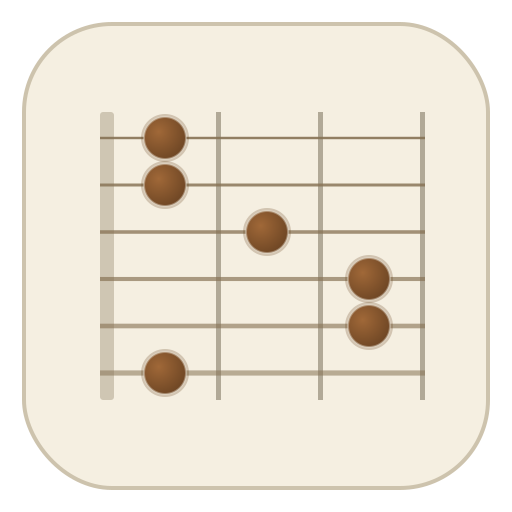

What a capo does
A capo clamps across all six strings at one fret and becomes a new nut. Every open string now sounds one half step higher for each fret the capo is up. Your chord shapes don't change at all: you play them exactly as you would in open position, with the capo standing in for the nut, and everything comes out higher.
Put a capo on the 2nd fret and play a G shape, and you hear A major. Play an Em shape and you hear F♯ minor.
The fret numbers in those diagrams count from the capo, the way song sheets write them. The notes underneath are what actually sounds.
Shape names and sounding names
This is the one thing that confuses people about capos: every chord now has two names. A song sheet that says “Capo 2” and then G, C and D means play those shapes. The chords that come out are A, D and E. Guitarists talk in shapes because that's what the hands do. Anyone else in the band, the bass player especially, needs the sounding names.
To get from one to the other, move every chord up by the capo number in half steps. The chart below does it for you.
Why use one
- To fit a singer. If a song in G sits too low for your voice, a capo lets you raise it a fret at a time until it fits, and you still play the same G, C and D shapes.
- To play in awkward keys without barres. E♭, A♭ and B♭ are full of barre chords in open position. Capo 1 with D shapes gives you E♭; capo 3 with G shapes gives you B♭.
- To keep open strings ringing. Open shapes have ringing strings that barre chords lose. A capo keeps that sound in any key.
- For a second guitar part. When two guitars play the same chords, one can play open C shapes while the other puts a capo on the 5th fret and plays G shapes. Both are playing C major, but the capo part sits higher and chimes over the other instead of doubling it.
Capo chart
Find the shape you're playing in the left column and the capo fret along the top. The cell is the chord you hear.
| Shape | Capo 1 | Capo 2 | Capo 3 | Capo 4 | Capo 5 | Capo 6 | Capo 7 |
|---|---|---|---|---|---|---|---|
| G | A♭ | A | B♭ | B | C | D♭ | D |
| C | D♭ | D | E♭ | E | F | F♯ | G |
| D | E♭ | E | F | F♯ | G | A♭ | A |
| A | B♭ | B | C | D♭ | D | E♭ | E |
| E | F | F♯ | G | A♭ | A | B♭ | B |
| Am | B♭m | Bm | Cm | C♯m | Dm | E♭m | Em |
| Em | Fm | F♯m | Gm | G♯m | Am | B♭m | Bm |
| Dm | E♭m | Em | Fm | F♯m | Gm | G♯m | Am |
Read it the other way to plan a song: to play in a key, find it in the table and use the shape and capo it sits under. Here are the options for every major key using the G, C, D, A and E shapes, lowest capo first:
| Key | Capo and shapes |
|---|---|
| C | capo 3, A shapes · capo 5, G shapes |
| D♭ | capo 1, C shapes · capo 4, A shapes · capo 6, G shapes |
| D | capo 2, C shapes · capo 5, A shapes · capo 7, G shapes |
| E♭ | capo 1, D shapes · capo 3, C shapes · capo 6, A shapes |
| E | capo 2, D shapes · capo 4, C shapes · capo 7, A shapes |
| F | capo 1, E shapes · capo 3, D shapes · capo 5, C shapes |
| F♯ | capo 2, E shapes · capo 4, D shapes · capo 6, C shapes |
| G | capo 3, E shapes · capo 5, D shapes · capo 7, C shapes |
| A♭ | capo 1, G shapes · capo 4, E shapes · capo 6, D shapes |
| A | capo 2, G shapes · capo 5, E shapes · capo 7, D shapes |
| B♭ | capo 1, A shapes · capo 3, G shapes · capo 6, E shapes |
| B | capo 2, A shapes · capo 4, G shapes · capo 7, E shapes |
Every chord page in the chord library has the same information for that one chord, with diagrams: see B♭ with a capo or F♯m with a capo.
Putting it on properly
- Just behind the fret, not on it and not halfway. Same spot your fingertip would go. Too far back and strings buzz; on top of the fret wire and they mute.
- Straight across. A capo at an angle presses some strings harder than others and pulls them out of tune.
- Only as tight as it needs to be. Too much pressure bends the strings sharp. If your adjustable capo has a screw, back it off until a string buzzes, then tighten a little.
- Check your tuning with it on. Even a well-placed capo can nudge a string or two sharp. A quick touch-up with the capo on saves the song.
The fretboard on this site has a capo too. Drag it up the neck and the note names, the chord name and the sound all follow, so you can check what a shape will sound like before you reach for the real thing.