
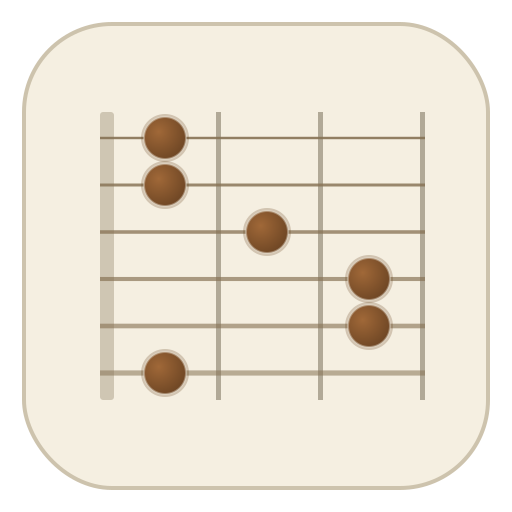

What the slash means
A slash chord is a chord with a specific bass note. The part before the slash is the chord; the part after it is the lowest note you play. C/E, read “C over E”, is a C major chord with E on the bottom. G/B is G major with B on the bottom.
It isn't a fraction and it isn't two chords. The notes on top are the same C major chord you already know; the slash just tells you which one goes underneath, or, in a band, what the bass player is playing.
Inversions: a chord tone in the bass
When the bass note is one of the chord's own notes but not the root, the chord is an inversion. Which inversion depends on which chord tone is in the bass:
| Bass note | Name | On C | On C7 |
|---|---|---|---|
| Root | Root position | C | C7 |
| 3rd | 1st inversion | C/E | C7/E |
| 5th | 2nd inversion | C/G | C7/G |
| 7th | 3rd inversion | (no 7th) | C7/B♭ |
Each one has the same notes as the root-position chord, so it does the same job in a progression. What changes is the weight. Root position sounds solid and finished. A 1st inversion is lighter and sounds like it's moving. A 2nd inversion is the least stable of the three and usually passes through on the way to something else.
Slash chord shapes worth knowing
Most of the useful ones are an open chord you already play with one finger moved or one more string added.
- C/E is the open C shape with the low E string let ring instead of muted. Nothing else moves.
- C/G moves your ring finger from the A string to the 3rd fret of the low E, then adds the A string back with your little finger.
- G/B is G with the low E muted, so the B on the A string becomes the bass.
- D/F♯ is an open D with the thumb over the top of the neck on the 2nd fret of the low E. The A string stays muted, usually by the side of the thumb.
- F/C is the F barre shape without the low string, so it needs only a small barre across the top two strings. It is how a lot of players get through F before the full barre comes easily.
- Am/G is Am with G added in the bass. G is the 7th of A minor, so this is also Am7 in 3rd inversion; the fretboard on this site names it Am7/G.
Why they're used: bass lines that walk
The main reason to reach for a slash chord is to make the bass move by step while the chords on top change. Compare a plain C, G, Am with the same chords and a slash in the middle:
The bass notes are C, B, A, G, F: a straight line down the scale. Without the slashes the bass would jump from C down to G and back up to A. The chords are the same; the line underneath them is what changes, and it is a sound you will recognise from a great many ballads.
The same trick works in G: G, D/F♯, Em walks G, F♯, E. Going up works too: C, C/E, F climbs C, E, F into the IV chord.
When the bass isn't in the chord
Sometimes the note after the slash isn't one of the chord's notes at all. D/C puts a C under a D major chord, which has D, F♯ and A. That C is the flat 7th of D, so the full sound is a D7 with its 7th in the bass, and the fretboard on this site names xx0232 with a C added on the A string as D7/C.
Chart writers often prefer the slash version anyway, because “play a D chord and put C in the bass” is quicker to read than working out a D7 inversion. Both names are right. The slash name describes how to play it; the other describes what it is.
How the fretboard names them
The identifier on the home page always treats the lowest string you play as the bass. If that note isn't the root, the name gets a slash and an inversion tag, so 032010 shows as C/E, 1st inversion, rather than quietly calling it C. Try it with the shapes above, and then try muting the low string to hear how the bass changes the chord.
The pages in the chord library list root-position shapes, the ones with the root in the bass. Once you know which string carries the root, you can usually find the inversions yourself by letting a different chord tone ring underneath.