
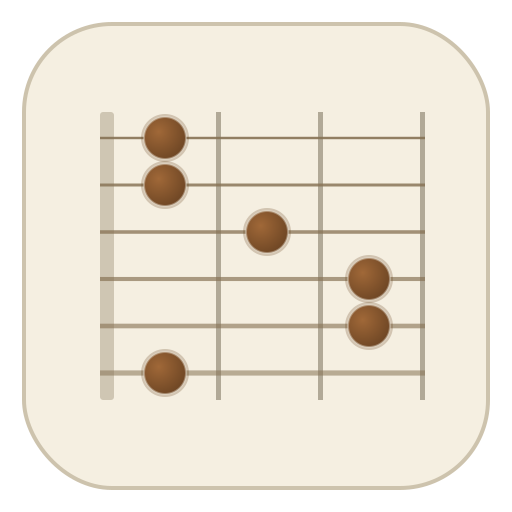

Everything is counted in half steps
Western music uses twelve notes: C, C♯/D♭, D, D♯/E♭, E, F, F♯/G♭, G, G♯/A♭, A, A♯/B♭ and B, then C again an octave higher. The step from one to the next is a half step, and on a guitar that is exactly one fret. The sharp and flat names are two spellings of the same pitch; which one a chord uses depends on its root, which is why C7 is written with a B♭ rather than an A♯.
A chord name is a description of which notes are stacked on a starting note, the root. The letter at the front is the root. Everything after it says what is built on top.
Intervals: the distance from the root
The distance from the root to each other note is an interval, and intervals are what chord names are really made of. Here they are measured from C:
| Half steps | Interval | In a chord symbol | From C |
|---|---|---|---|
| 0 | Root | 1 | C |
| 2 | Major 2nd | 2 or 9 | D |
| 3 | Minor 3rd | ♭3 | E♭ |
| 4 | Major 3rd | 3 | E |
| 5 | Perfect 4th | 4 or 11 | F |
| 6 | Tritone | ♭5 or ♯11 | G♭ or F♯ |
| 7 | Perfect 5th | 5 | G |
| 8 | Augmented 5th or minor 6th | ♯5 or ♭13 | G♯ or A♭ |
| 9 | Major 6th | 6 or 13 | A |
| 10 | Minor 7th | ♭7 | B♭ |
| 11 | Major 7th | 7 | B |
The 9, 11 and 13 are the 2nd, 4th and 6th counted an octave up. Chord symbols use the higher numbers for notes added on top of a chord (C9, Cadd9) and the lower ones for a note that replaces the 3rd (Csus2, Csus4) or for the 6th in a 6 chord.
Triads: the four basic chords
Stack two 3rds on a root and you get a triad, three notes: a root, a 3rd and a 5th. There are four kinds, depending on whether each 3rd is major (four half steps) or minor (three).
- Major (1 3 5): a major 3rd, then a minor 3rd. C E G. Written as the letter alone: C.
- Minor (1 ♭3 5): a minor 3rd, then a major 3rd. C E♭ G. Written Cm, sometimes Cmin or C–.
- Diminished (1 ♭3 ♭5): two minor 3rds. C E♭ G♭. Written Cdim or C°.
- Augmented (1 3 ♯5): two major 3rds. C E G♯. Written Caug or C+.
The 3rd decides major or minor. Play C and then Cm and only one note changes: E drops to E♭. That single half step is the whole difference between a bright chord and a dark one.
Reading the rest of the symbol
Everything else in a chord name adds a note to one of those triads or swaps one out. The table shows the common symbols built on C. Each name links to its page in the chord library.
| Symbol | Name | Formula | Notes |
|---|---|---|---|
| C | Major | 1 3 5 | C E G |
| Cm | Minor | 1 ♭3 5 | C E♭ G |
| Cdim | Diminished | 1 ♭3 ♭5 | C E♭ G♭ |
| Caug | Augmented | 1 3 ♯5 | C E G♯ |
| Csus2 | Suspended 2nd | 1 2 5 | C D G |
| Csus4 | Suspended 4th | 1 4 5 | C F G |
| C7 | Dominant 7th | 1 3 5 ♭7 | C E G B♭ |
| Cmaj7 | Major 7th | 1 3 5 7 | C E G B |
| Cm7 | Minor 7th | 1 ♭3 5 ♭7 | C E♭ G B♭ |
| Cm7♭5 | Half-Diminished | 1 ♭3 ♭5 ♭7 | C E♭ G♭ B♭ |
| C6 | Major 6th | 1 3 5 6 | C E G A |
| Cadd9 | Added 9th | 1 3 5 9 | C E G D |
| C9 | Dominant 9th | 1 3 5 ♭7 9 | C E G B♭ D |
| Cmaj9 | Major 9th | 1 3 5 7 9 | C E G B D |
A few rules cover almost everything in it:
- A plain 7 means the flat 7th. C7 is C E G B♭. This is the dominant 7th, the bluesy, wants-to-move chord. For the natural 7th, B, the symbol has to say maj7: Cmaj7 is C E G B, which sounds soft and jazzy instead.
- The m belongs to the 3rd, not the 7th. Cm7 is a minor triad with a flat 7th: C E♭ G B♭. A minor triad with a natural 7th is written Cm(maj7).
- 9, 11 and 13 on their own include the 7th. C9 is C7 with a D on top: C E G B♭ D. To add the D without the 7th, the symbol says add: Cadd9 is C E G D.
- sus replaces the 3rd. Csus2 swaps E for D, and Csus4 swaps it for F. With no 3rd, the chord is neither major nor minor, which is what gives it its open, waiting-to-land sound.
- 6 adds the 6th without a 7th. C6 is C E G A.
- m7♭5 is a minor 7th with a flattened 5th, also called half-diminished and written Cø. It is the chord on the 7th degree of a major key: Bm7♭5 in C major.
What changes on a guitar
Six strings and four fingers mean guitar chords rarely look like the textbook version. Three things are normal and don't change the name:
- Doubled notes. Open G (320003) has three Gs, two Bs and a D. It is still just G B D.
- Order above the bass. Which string carries the 3rd and which the 5th changes the colour, not the name.
- A missing 5th. The 5th adds the least character of any chord tone, so bigger chords often drop it to free up a string. Most guitar 9th chords have no 5th.
The bass note is the exception. The lowest note you play matters a lot, and when it isn't the root the chord gets a slash: C with E in the bass is C/E. The guide to slash chords covers those.
When the same notes have two names
C6 is C E G A. Am7 is A C E G. Those are the same four notes, so which is it? It depends on which note you hear as home, and on a guitar that is mostly the bass note. Put C on the bottom and it sounds like C6. Put A on the bottom and it sounds like Am7.
Plenty of shapes have more than one honest reading like this. The common C6 shape, x32210, has no G at all. It is C, E and A, so it could equally be called A minor with C in the bass, Am/C. Musicians pick the name that fits what the song is doing, which is why the fretboard on this site shows its best guess first and lists the other readings underneath instead of insisting on one.
Naming a shape you found by accident
Say you land on x32033 and want to know what it is. Work it out in four steps.
- List the notes. A string 3rd fret is C, D string 2nd fret is E, the open G string is G, B string 3rd fret is D, high E 3rd fret is G.
- Drop the repeats. C, E, G, D.
- Try the bass note as the root and measure the others from it. From C: E is a major 3rd, G a perfect 5th, D a major 2nd, which on top of a chord reads as the 9.
- Match it to a formula. 1 3 5 9 with no 7th is an add9 chord. This shape is Cadd9.
If nothing fits with the bass as the root, try each of the other notes as the root instead. When one of them fits, you have a slash chord. If you'd rather skip the arithmetic, put the shape on the fretboard and it will do these steps for you, for every possible root, and rank the results.